
Every year, thousands of international students graduate from UK universities with strong degrees, technical skills, and high expectations. Yet many of them struggle to secure interviews — let alone job offers.
Contrary to popular belief, this is not because international students lack skills or intelligence.
In most cases, the problem is strategy, not ability.
Based on years of experience working with international students in UK higher education, here are the key mistakes that quietly block job opportunities after graduation.
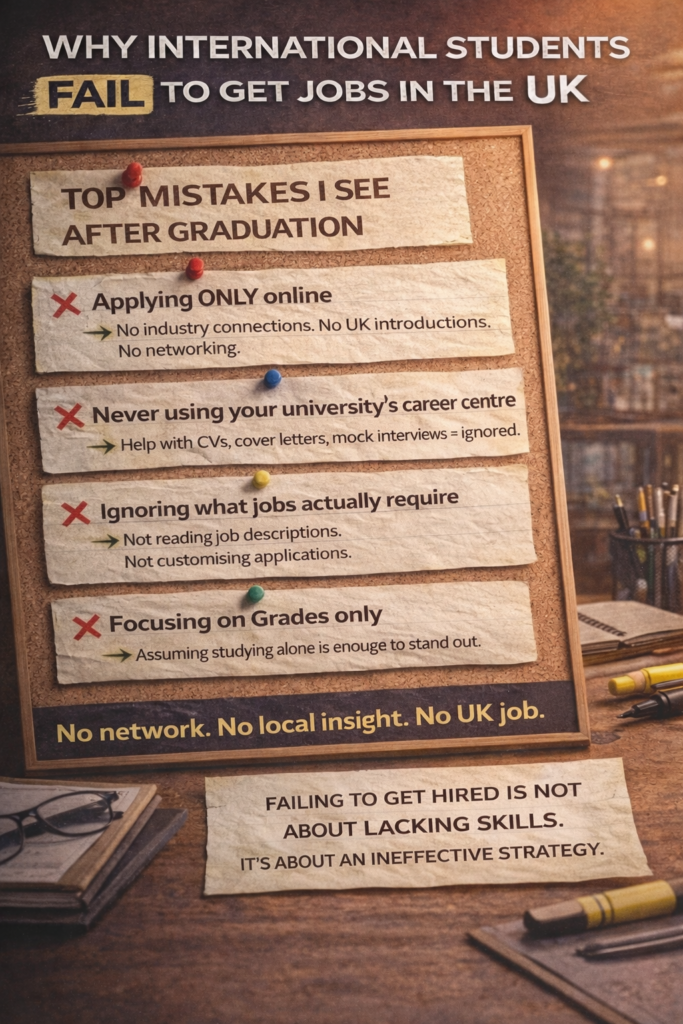
1. Applying Only Online (And Expecting Results)
One of the biggest mistakes international students make is relying entirely on online job applications.
UK employers receive hundreds of applications for a single role. If your application enters the system without any internal reference, context, or recommendation, it is often filtered out quickly — regardless of your qualifications.
What’s missing:
- Industry connections
- UK professional introductions
- Networking beyond LinkedIn “Apply” buttons
Online applications alone rarely work — especially for international candidates.
2. Ignoring the University Career Centre
Most UK universities offer:
- CV and cover letter reviews
- Mock interviews
- Employer networking events
- Internship and placement opportunities
Yet many international students never use these services or discover them too late.
This is a critical mistake.
UK employers value candidates who understand UK recruitment standards, not just academic excellence. Career centres help translate your background into language UK employers recognise.
3. Not Understanding What Jobs Actually Require
Another common issue is applying for roles without carefully analysing job descriptions.
Many international students:
- Apply to dozens of roles without tailoring applications
- Focus on degree titles rather than required competencies
- Miss keywords, tools, and behavioural expectations
UK employers are not hiring “degrees” — they are hiring problem-solvers who can demonstrate relevance.
If you do not align your CV and applications with the role requirements, your chances drop immediately.
4. Focusing on Grades Instead of Employability
High grades are valuable — but they are not enough in the UK job market.
Employers look for:
- Practical experience (even part-time or voluntary)
- Evidence of applied skills
- Communication in a professional UK context
Many international students assume that academic performance alone will make them stand out. Unfortunately, this assumption often delays employment outcomes.
5. Lacking a Clear UK Job Search Strategy
The most overlooked issue is the absence of a structured job search strategy.
International students often:
- Apply randomly
- React emotionally to rejections
- Follow advice from friends rather than evidence
- Underestimate how early preparation matters
Failing to secure a job is rarely about talent.
It is usually about misalignment between expectations and reality.
The Real Issue: It’s Not Skills — It’s Strategy
Most international students who struggle in the UK job market are:
- Educated
- Capable
- Hard-working
What they lack is clarity on how the UK system works.
Understanding recruitment culture, employer expectations, networking norms, and application strategy makes a measurable difference.
Final Thought
If you are an international student in the UK and not getting interviews, pause before assuming something is “wrong” with you.
More often than not, the issue is how you are approaching the job market, not who you are.
With the right guidance, preparation, and realistic strategy, outcomes change.