
A Lecturer’s Perspective on Mindset, Strategy, and Responsibility
Every year, I meet international students who are intelligent, motivated, and ambitious — yet deeply frustrated.
They’ve done what they were told would work:
They came to the UK.
They paid high tuition fees.
They earned a UK degree.
And still, job sponsorship feels out of reach.
The uncomfortable truth is this: a degree on its own is no longer a strategy. It may have been enough for previous generations. It is not enough today.
The Core Misunderstanding
Many students implicitly believe:
“If I get a UK degree, opportunities will open automatically.”
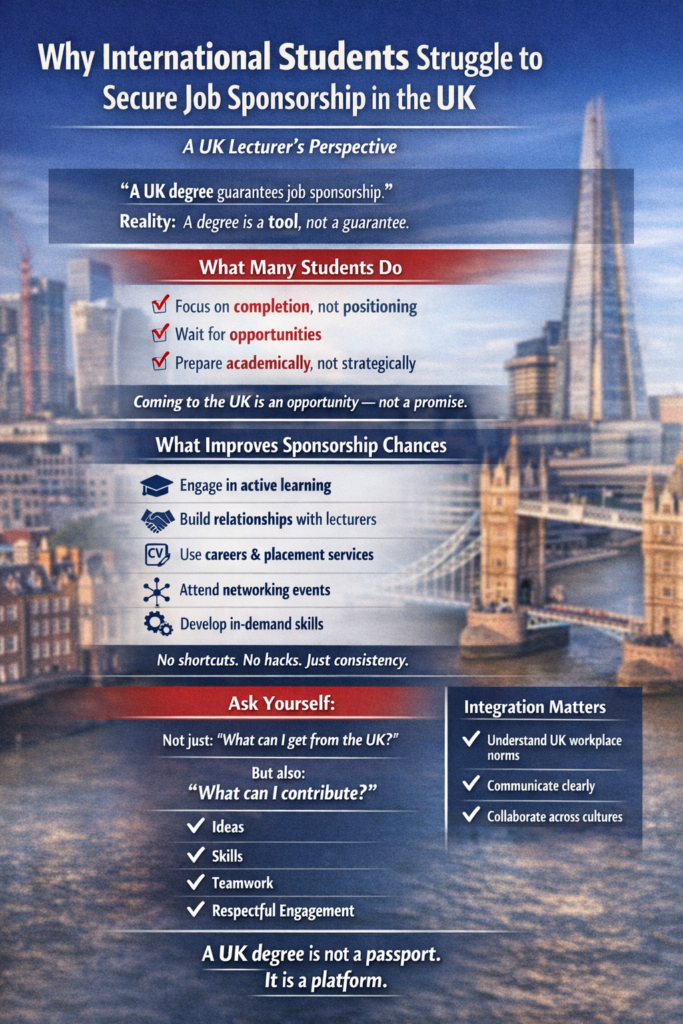
This belief quietly shapes behaviour. Students focus on completion rather than positioning. They wait rather than engage. They prepare academically, but not strategically.
A degree is a tool, not a guarantee.
Coming to the UK is an opportunity, not a promise.
In today’s labour market, employers do not sponsor potential alone — they sponsor demonstrated value.
What a Better Strategy Looks Like
From my experience in UK higher education, students who improve their chances of sponsorship tend to do a few things differently.
They engage actively in their learning — not just attending classes, but questioning, applying, and connecting theory to practice.
They build professional relationships with lecturers — not to ask for favours, but to seek guidance, feedback, and perspective. Many academics have industry links, consultancy experience, or insight into how employers actually think.
They use university careers and placement services early and properly. CVs, interviews, and professional communication in the UK follow specific norms. Ignoring this is costly.
They attend networking events and industry meet-ups — not to ask for jobs, but to understand skill gaps, sector challenges, and expectations. Relationships come before opportunities.
Most importantly, they listen carefully when professionals tell them which skills matter — and then they work deliberately to develop those skills.
This approach is not quick. It is not glamorous. But it works.
The Myth of the “Quick Fix”
There is no magic visa route.
There is no guaranteed sponsorship shortcut.
There is no immigration “hack”.
Anyone suggesting otherwise is selling hope, not reality.
Sponsorship is the outcome of trust, contribution, and consistency over time. It requires effort, resilience, and sacrifice.
Big ambitions demand proportionate commitment.
A Question Students Rarely Ask — But Should
There is another dimension that is often missing from these conversations.
When you come to the UK, ask yourself not only:
What can I get from this country?
But also:
What can I contribute to it?
If your mindset is purely extractive — degree, job, visa — it shows. Employers and colleagues may not articulate it, but they sense it.
The UK does not invest in people simply because they want to stay. It invests in those who add value to workplaces, communities, and society.
This doesn’t require grand gestures. It requires a shift in orientation.
Contributing ideas.
Improving processes.
Supporting teams.
Engaging respectfully with diverse communities.
Belonging begins with contribution.
Integration Is Not Optional
Students who thrive long-term are not those who remain on the margins, socially or professionally.
They make an effort to understand workplace norms.
They communicate clearly.
They collaborate across cultures.
They treat the UK not as a temporary extraction point, but as a shared space.
That mindset matters — more than many realise.
A Final Reflection
A UK degree is not a passport.
It is a platform.
What you build on it determines your trajectory.
Students who approach their time in the UK with planning, humility, contribution, and persistence don’t just increase their chances of sponsorship — they become professionals others want to invest in.
That difference begins with mindset.